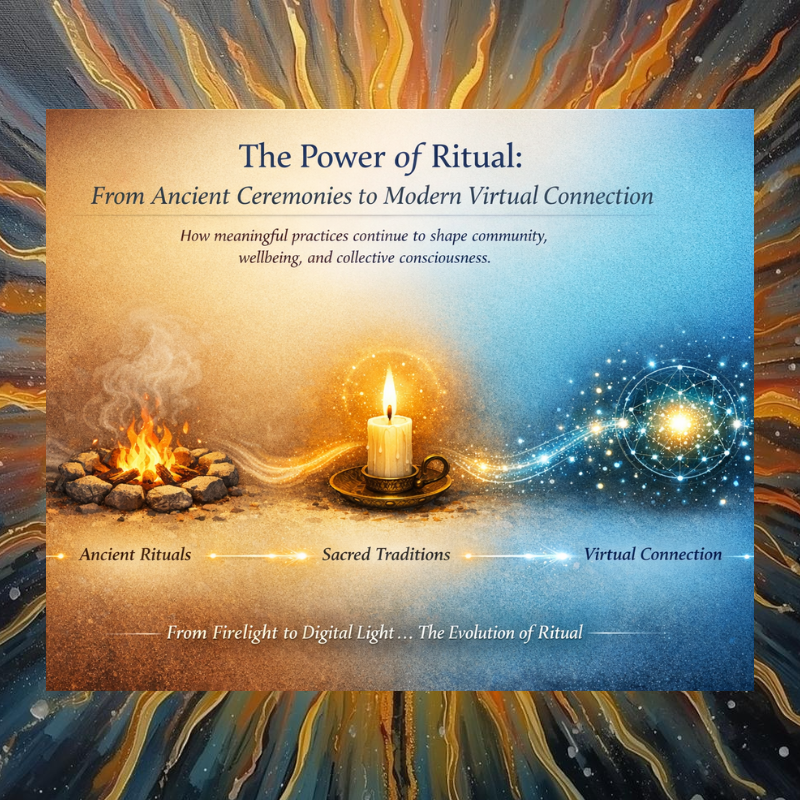
How meaningful practices continue to shape community, wellbeing, and collective consciousness.
In every culture across the world, humans have created rituals—intentional moments that bring meaning, connection, and reflection into daily life. Whether gathered around ancient fires, inside sacred temples, or within modern communities, people have long used rituals to mark important transitions and to reconnect with what truly matters.
Today, as technology reshapes the way we gather and communicate, rituals are beginning to evolve in fascinating ways. Yet their deeper purpose remains unchanged: to help us pause, align our intentions, and remember our connection to one another and to the greater web of life.
Across every culture and era of human history, rituals have played a powerful role in shaping how people experience life, community, and transformation. From ancient temple ceremonies to modern mindfulness practices, rituals help us pause, reflect, and connect with something greater than ourselves.
While the form of rituals may evolve over time, their purpose remains remarkably consistent. Rituals create meaning, strengthen community bonds, and guide individuals through life’s many transitions. They provide structure during uncertain times and allow us to symbolically express values that might otherwise be difficult to articulate.
In many ways, rituals serve as a bridge between the practical realities of daily life and the deeper dimensions of human consciousness.
Guiding Life’s Transitions
One of the most universal functions of ritual is helping individuals navigate major life changes. Anthropologist Arnold van Gennep described these ceremonies as “rites of passage,” symbolic experiences that mark the movement from one stage of life to another.
These rituals help both individuals and communities acknowledge transformation and create meaning around it. Some examples include:
- Birth and naming ceremonies
- Coming-of-age traditions
- Marriage ceremonies
- Graduation celebrations
- Funeral and remembrance rituals
Through shared symbols, words, and actions, rituals provide a sense of continuity during times when life is shifting.
Strengthening Community and Shared Identity
Rituals also bring people together. Sociologist Émile Durkheim famously described the emotional energy generated during shared ceremonies as “collective effervescence.” In these moments, individuals feel part of something larger than themselves.
Even in modern society, we continue to gather around rituals that reinforce connection and shared identity such as:
- Cultural and religious ceremonies
- National holidays and ‘remembrance’ days
- Community festivals
- Sporting traditions
- Graduation and award ceremonies
These moments remind us that we are not navigating life alone; we are part of a broader human story.
Creating Stability in Uncertain Times
Human beings naturally seek patterns and meaning. Rituals provide a sense of order and predictability, especially during stressful or uncertain moments.
Research in psychology suggests that intentional rituals can help reduce anxiety, improve focus, and create emotional grounding. Even simple personal rituals can cultivate a sense of calm and purpose.
Common everyday rituals may include:
- Morning meditation or prayer
- Lighting a candle before reflection or journaling
- Setting daily intentions
- Gratitude practices
- Evening wind-down routines
These practices may seem small, yet they create meaningful moments of awareness that anchor us throughout the day.
Connecting the Physical and the Sacred
“From ancient fire circles to emerging virtual worlds, rituals remind us that humans have always gathered with intention—to create meaning, connection, and shared consciousness.”
For many ancient cultures, rituals were also understood as a way to align human life with a greater cosmic order. Ceremonies honored natural cycles, ancestors, and spiritual forces that were believed to guide the unfolding of life.
Spiritual traditions such as Buddhism, Hinduism, and Shamanism all incorporate rituals designed to deepen awareness and cultivate harmony between the individual and the universe.
Through symbolism, movement, sound, and intention, rituals allow people to experience the sacred not only as an idea, but as a living moment of connection.
Preserving Wisdom Across Generations
Long before written language, rituals served as living archives of knowledge. Stories, chants, gestures, and ceremonial practices helped communities pass down cultural teachings, ecological understanding, and spiritual insights.
In this way, rituals became embodied wisdom traditions—practices that preserved collective knowledge while strengthening cultural identity.
They were, and still are, powerful ways of remembering who we are and what we value.
The Evolution of Rituals in the Digital Age
As technology reshapes the way humans connect and communicate, rituals are beginning to evolve into new forms. Virtual gatherings, immersive environments, and shared digital experiences are opening the door to a new frontier of collective ritual.
In online spaces and emerging metaverse environments, people are already experimenting with new ceremonial expressions, including:
- Global meditation events held simultaneously across time zones
- Virtual memorials and remembrance gatherings
- Digital celebrations and community ceremonies
- Collective intention-setting events in immersive virtual spaces
These emerging practices suggest that ritual is not tied to a specific place or technology. Instead, it reflects a deeper human need to create meaning together.
Some researchers and consciousness scholars believe that shared digital experiences could even amplify what Émile Durkheim described over a century ago. When people gather simultaneously in virtual environments with shared intention, they may generate powerful moments of collective awareness.
In this sense, virtual rituals could become new pathways for exploring collective consciousness, bringing people from around the world into shared moments of reflection, healing, creativity, and possibility.
A Timeless Human Practice
From ancient fire circles to digital worlds, rituals continue to evolve alongside humanity. Yet their essence remains unchanged.
- They remind us to pause.
- To acknowledge life’s transitions.
- To connect with one another.
And to remember that even in a rapidly changing world, the human spirit still longs for meaning, presence, and shared experience.
In honoring ritual—whether ancient or newly imagined—we participate in one of humanity’s oldest and most powerful traditions: the conscious act of gathering intention, awareness, and community to shape the world we wish to create.
As we continue exploring new frontiers of technology, the future of ritual may expand beyond physical spaces into shared digital environments. Virtual communities, immersive experiences, and global gatherings could create opportunities for people across the world to participate in collective moments of reflection, intention, and healing.
The form may change, but the heart of ritual remains the same: a conscious pause in the flow of everyday life where we gather meaning, awareness, and connection.
Perhaps the most important question is not whether rituals will continue, but how we choose to shape them.
What rituals—ancient or newly imagined—might help us cultivate greater wellbeing, creativity, and collective consciousness in the years ahead?
Blog collaboratively written by Esperanza Smith and ChatGPT.